





With homelessness rising in Glasgow and targets to build new homes not being delivered, the city must look to different solutions to this stubborn problem.
Across the city, there are thousands of people, registered as homeless, living in temporary accommodation.
It ranges from hostels, hotels and B&Bs to flats secured from housing associations but only as a temporary address for people who need a settled home of their own.
There are many reasons why homelessness is rising, which have been well rehearsed, including the cost of living, addiction, mental health and immigration.
Read more
Glasgow's health board say it's 'incredibly challenging' to find temporary accommodation for large families
Shocking number of people forced to live in temporary accommodation revealed
Huge jump in homeless people in hotels in Glasgow recorded this year
Another rise in women in homeless hotel amid call for female only spaces
Are refugees given priority for social housing in Glasgow?
While many politicians and citizens choose to engage in arguments about who is deemed worthy of publicly funded support, the facts remain.
Almost 10,000 people are homeless in Glasgow. 3367 of them are children and almost 3000 people in hotels and B&Bs, despite all the words, there is no tangible sign of improvement.
Recent figures showed new build social housing completions reached a decade's long low.
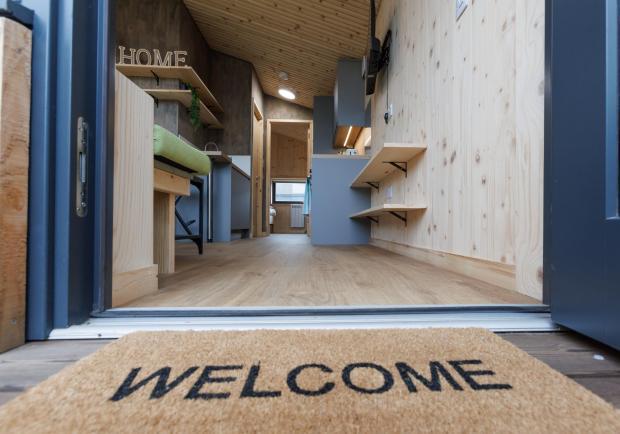
Last week, a new village in Rutherglen was opened by the charity Social Bite.
It will provide accommodation for 15 people with on-site support available.
The accommodation units themselves are of modular construction.
The method has been used elsewhere, in Edinburgh and in England.
Previously, to tackle a housing shortage, Glasgow had prefabs. Many are still standing today, far outlasting the expected lifespan.
Could modular housing be a solution to Glasgow’s housing emergency, or a part of it?
A study by researchers at Cambridge University in 2022 found 33 schemes in 22 local authorities across the UK.
They identified some challenges with the schemes, costs, location, standards and suitability were all pinpointed.
But it can still be a useful weapon in a battle that currently is being lost.
It takes years to build traditional homes and it costs a lot of money.
In Glasgow, the cost of building one social housing unit has been put at £250,000.
Modular homes are far cheaper, a fraction of the quarter of a million, and can be in place far quicker.
Another challenge was the availability of land, the location and access to existing services and amenities.
For a city-wide solution Glasgow would need to utilise the enormous amount of land, fortunately the city is blessed with an abundance of vacant land in and around our communities.
The modular homes are smaller and don’t meet size standards.
But would any seriously argue that it is better to keep people in hotels and B&Bs, many of which are unfit to live in and according to many of those who have experienced this, actually make their lives worse.
The Social Bite scheme has the Salvation Army providing the support and Glasgow also has a skilled and dedicated third sector to work with the public sector in delivering the care needed.
Social Bite village with 15 residents can help but in small numbers targeted at those identified to benefit most.
Glasgow would need to replicate this on a much bigger scale to start to make inroads on a problem that has grown to scandalous proportions.
But it could be delivered.
If the city was to adopt a strategy of building using modular homes as temporary accommodation, the current temporary flats could be flipped into permanent tenancies.
In England, one form of modular housing, Solohaus, sees unit built in 30 days and have a lifespan of 60 years, cost around £5 a week in electricity. A plan for 200 units over five years was agreed.
Another plan by the charity Centrepoint was for 300 units for single occupancy at a cost of £50,000 per unit.
With an election weeks away the political parties are proposing solutions to the housing situation, some taking it more seriously than others.
There are targets that history tells us are rarely reached and pledges that sound good but are empty without the financial muscle to drive them.
What is needed is a fully costed plan and a mission backed with the sort of government cash that can back up the tough talk.
While there is a housing emergency recognised by both the city council and the Scottish Government, there needs to be action radically different to recent years.
Modular housing backed with the support people need has to be seriously considered as part of that solution.


Share