


The consequences of forcing an Orange Order march down the Garvaghy Road in Portadown “could be catastrophic”, Police Service of Northern Ireland (PSNI) Chief Constable Jon Boutcher has said.
He also told the Policing Board in Belfast that there will be “consequences” for those who blocked the road, “especially those who incited and organised it”.
The chief constable also defended how his force delivered intelligence assessments to the Parades Commission ahead of its determination over the contentious march, and said he currently does not believe it is necessary to ask the Secretary of State to review that determination.
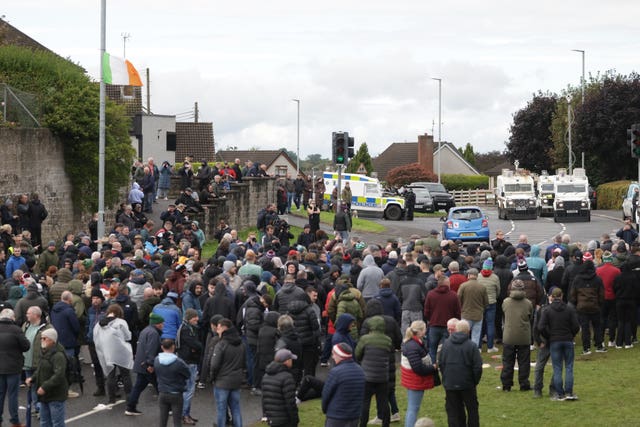
On Sunday, an Orange Order parade from Drumcree Church into Portadown did not happen due to a large protest on the mainly-nationalist Garvaghy Road. Sinn Féin vice-president Michelle O’Neill was among those who took part in the protest.
Mr Boutcher faced questions about the policing operation when he appeared before his scrutiny body on Thursday.
He said: “It feels like the world’s watching what’s happening at the moment, so I think we all need to try to conduct ourselves in the very best way we possibly can for the future of this place.”
He told the board the situation at Drumcree remained “challenging and complex”.
He added: “But the central fact is that, despite very significant tensions, there has been no violence, and no-one has been injured. Police have kept people safe and maintained separation of the two parties.
“I’ve made it clear to my senior team that our objective is to facilitate the Parades Commission determination.
“The Parades Commission determination means that the Orange Order can lawfully parade down the Garvaghy Road. Without that determination, such a parade would be unlawful.
“What it does not mean, however, is that the police must accommodate that determination at all costs, which some people seem to comment upon.”
Mr Boutcher told the board he has a responsibility to preserve peace and maintain order.
He said: “We are not back in 1997. We are not expected, and nor will we, force members of the Orange Order, many of whom are of a certain age, through a hostile crowd, which will be unsafe and will be disproportionate, and where the wider consequences for Northern Ireland could be catastrophic.
“My aim, our aim, is to facilitate the determination, but in a proportionate and safe way.
“The parade could not safely be facilitated on Sunday September 27 because of an unnotified protest that blocked the route. Officers repeatedly engaged with those involved and issued warnings.
“We considered a range of options, but assessed that the use of force required to clear the road risked serious harm and an escalation into disorder. That would not have been proportionate.
“The determination does not mean that the PSNI will move down the Garvaghy Road with force.”
He said an evidence gathering operation into the blocking of the road is under way.
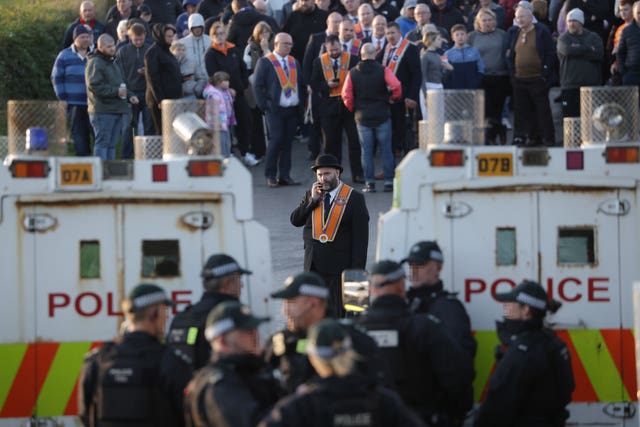
Mr Boutcher said: “Standing in the street, blocking the lawful parade, will have criminal justice consequences for those involved, especially those who incited and organised it.
“People need to understand that standing in the street to block a lawful parade is not without its consequence.
“We’ve gathered evidence from the outset and established a dedicated and significant inquiry team. Anyone suspected of breaking the law will be investigated.
“Where the evidence supports it, cases will be put to the Public Prosecution Service, and this process will be expedited.”
He added: “The rule of law has to prevail.
“I want to reiterate that there’s a responsibility on everyone, as I’ve said repeatedly, publicly, to call for calm, not to incite unrest or illegal activity.
“That especially includes elected representatives and others with influence.”
The chief constable praised the actions of his officers in a challenging environment.
He said: “Notwithstanding being insulted and abused, the PSNI is the shock absorber for when society fractures.
“People would do well to realise what an outstanding police service they have.”
The chief constable was asked about PSNI interactions with the Parades Commission, which gave the go-ahead for the Drumcree march, ahead of the determination.
He said a legal challenge to the determination would be heard on Friday, so he would proceed “with care”.
“I am very satisfied with regards to the presentations that were made by the PSNI and the way we conducted that process,” he said.
“This judgment describes that in good detail, and I think provides an assessment that we conducted our role in that process properly, and indeed so too of the Parade Commission.”
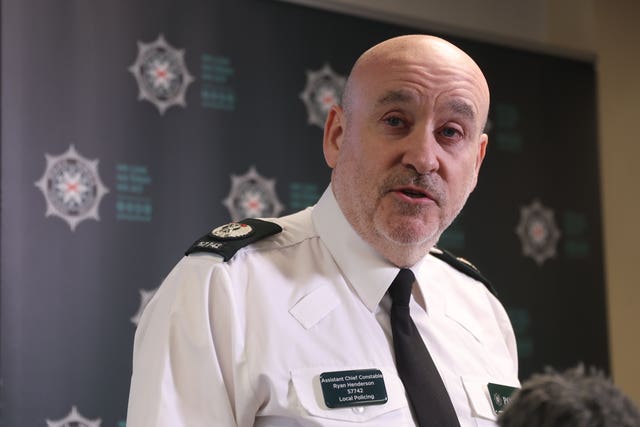
He said when the PSNI provided evidence to the commission in advance of its determination, it had to “address a full range of possible scenarios”.
He said Assistant Chief Constable Ryan Henderson had provided commissioners with an intelligence assessment “outlining the limited information that was available at the time”.
He said: “Our intelligence assessment, which was read in full to the commission, set out that there was currently no intelligence to indicate disorder was being planned in relation to the parade.
“ACC Henderson reinforced that due to the lack of intelligence, PSNI was actively planning against an unclear picture of what may arise from either potential outcome from the Parades Commission, as of the then unknown determination, and that consequently the PSNI had had to plan for a range of scenarios, ranging on a scale from peaceful all the way up to and including violent disorder.
“ACC Henderson informed the commissioners that the planning included the mobilisation of significant resource to provide a policing response.”
Mr Boutcher said a request for mutual aid support from other police forces was made on September 21 as a “contingency measure”.
He added: “We applied ourselves to this process in a proper and fair way.
“We did our job and, as I understand it, the commission did theirs.”
He was also asked why he had not so far asked Northern Ireland Secretary Sir Chris Byrant to review the Parades Commission determination.
Mr Boutcher said: “There is an opportunity for me as the chief constable, if I deem it appropriate, to apply to the Secretary of State to review a Parades Commission determination.
“There is further legislation within that Act under Section 11, which provides the Secretary of State with a series of comprehensive powers.
“The board simply needs to be reassured that I am constantly reviewing that position.
“But at this stage, it is my judgment that that is not necessary.
“We are creating the time to resolve this, and that is in the interests of everyone.”


Share